
Kolak Fan Holding
Kolak Fan Company is one of the leading manufacturers of industrial kitchen hoods in Iran and offers a variety of products
Industrial hoods:
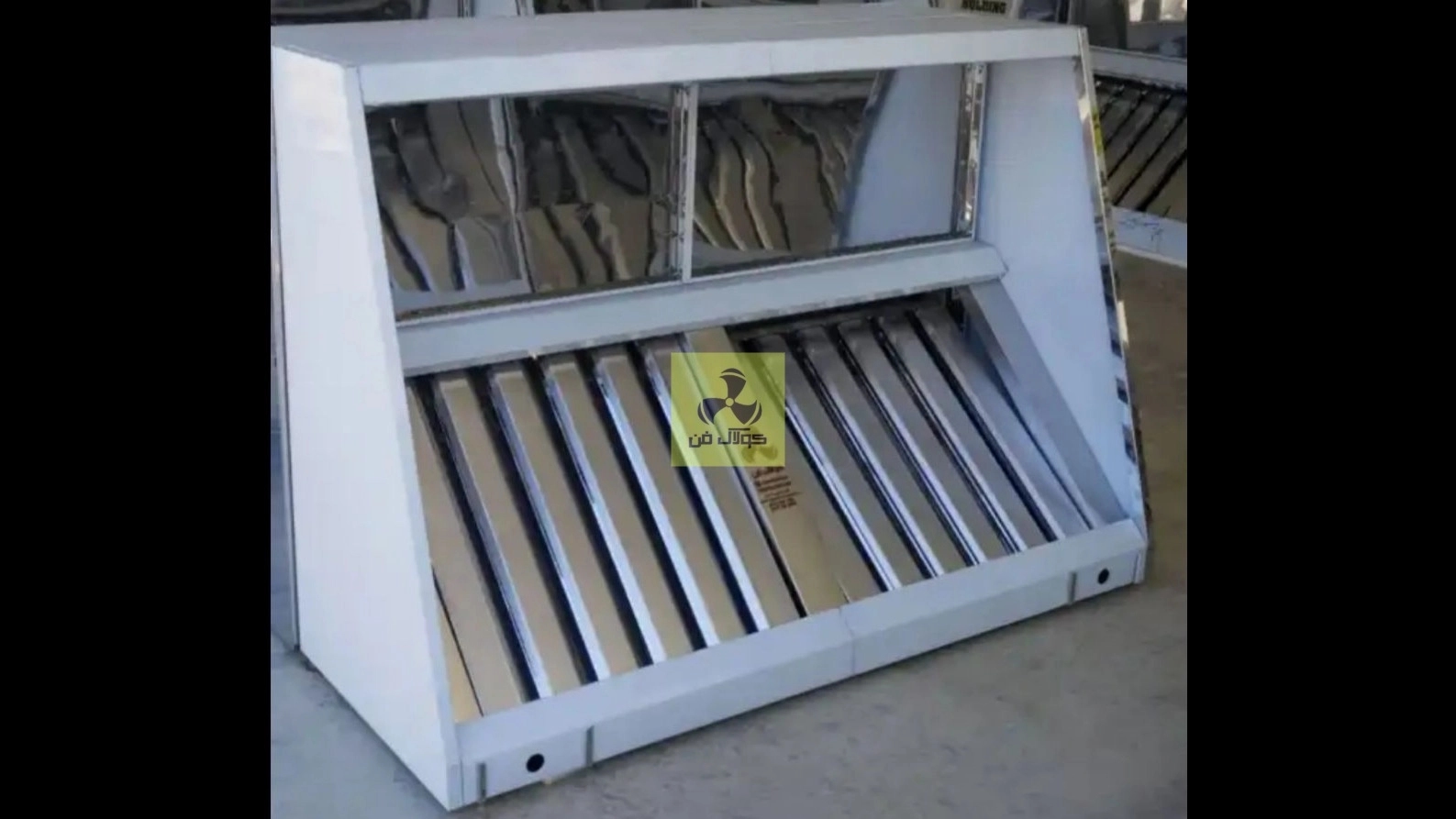
Industrial hoods are devices designed to ventilate and purify polluted air in industrial environments, especially industrial kitchens, restaurants, workshops and factories. These hoods improve the air quality of the environment and increase safety and health by sucking smoke, steam, fat, harmful gases and unpleasant odors.
Types of industrial hoods
Industrial hoods are divided into different types based on design, application and ventilation mechanism:
- Wall-mounted hood:
- Suitable for kitchens where the cooking equipment is close to the wall.
- It is open on three sides and is connected to the wall.
- Easy installation and reasonable price are its advantages, but its suction power may be limited for large kitchens.
- Suitable for large kitchens with cooking equipment in the center.
- High suction power, but requires more space and more complicated installation.
- Enclosed hood:
- Completely or partially surrounds the source of pollutants.
- Suitable for environments such as paint booths or grinding stations.
- In two types. Complete and partial (partial) available.
- Single-wall and double-wall hoods:
- Single-wall: lighter, more economical and suitable for environments with less pollution. It only transports polluted air to the outside.
- Double room: more advanced, with the ability to let fresh air in and drain pollutants faster. Suitable for large restaurants with the need to reduce noise and increase durability.
- Channel hood:
- Uses a ducting system to transport polluted air outside.
- Suitable for industrial environments with high volume of pollutants.
- Fume hood without chimney:
- Filters polluted air and returns clean air to the environment.
- More for use It is suitable for homes and is less efficient in industrial environments with high pollution.
- Fat extractor hood:
- Equipped with special filters to absorb grease suspended in the air.
- Prevents the accumulation of grease on surfaces and equipment.
- Cube hood:
- It has a cube design and offers a different appearance compared to sloping hoods.
- For industrial kitchens with The need for special design is appropriate.
Technical specifications of industrial hoods
- Body material:
- They are usually made of stainless steel (grade 304 or 430), anodized or galvanized aluminum. 304 steel is the most widely used option due to its high resistance to corrosion and moisture.
- Sheet thickness: 0.6 to 2 mm (depending on the hood type).
- Filters:
- Grease filters (steel or aluminum), activated carbon, HEPA or electrostatic filters to absorb suspended particles and gases. Harmful.
- Fan:
- Usually a centrifugal type with high suction power (in cubic meters per hour - m³/h).
- Channeling system:
- Round or rectangular channels are used to transport polluted air outside.
- Lighting:
- Equipped with an internal lighting system to improve visibility in the environment. work.
- Other features:
- Smoke and gas sensors, engine speed adjustment switch, and a sink for washing filters.
Advantages of industrial hoods
- Improving air quality: removing smoke, steam, grease and unpleasant odors.
- Increasing safety: reducing the risk of fire due to the accumulation of grease and flammable gases.
- Reducing maintenance costs: preventing the accumulation of pollution on equipment and walls, increasing the life of equipment.
- Complying with health standards: the requirement of many regulatory organizations to use industrial hoods. Cooler and safer working environment.
- Sound reduction: advanced hoods are equipped with sound reduction technologies.
Applications of industrial hoods in places like:
- Industrial kitchens, restaurants, hotels and fast foods
- Manufacturing workshops and factories
- Laboratories
- Hospitals and treatment centers
- Environments with the production of chemical pollutants or dust are used.
Important points in choosing an industrial hood
- Suction power: must be proportional to the volume of pollutants in the environment (in m³/h).
- Dimensions and design: the hood must be in harmony with the size and layout of the kitchen or industrial environment.
- Sound level: hoods with sound reduction technology are more suitable for sensitive environments.
- Materials and construction quality: 304 grade stainless steel hoods are recommended for durability and better hygiene.
- Filters: Washable and replaceable filters reduce maintenance costs.
- Certificates and standards: hoods with international standards (such as ISO) have higher quality and safety.
Industrial hood price
The price of industrial hoods depends on several factors:
- Body material (steel, aluminum, galvanized)
- Hood type (single wall, double wall, wall, central)
- Suction power and dimensions
- Additional features such as sound reduction systems or sensors
How to install
The installation of industrial hoods should be done by professionals and includes: choosing the right place (above the cooking equipment or pollutant source)
Installation of ducting for air transfer
Connecting to the electrical system with fireproof wiring
Setting filters and fans for optimal performance.
In general, industrial hoods with high suction power, good manufacturing quality and diversity in design are suitable for ventilation and maintaining hygiene in various industrial kitchens.
For more information, contact:
09124598284
09121865671